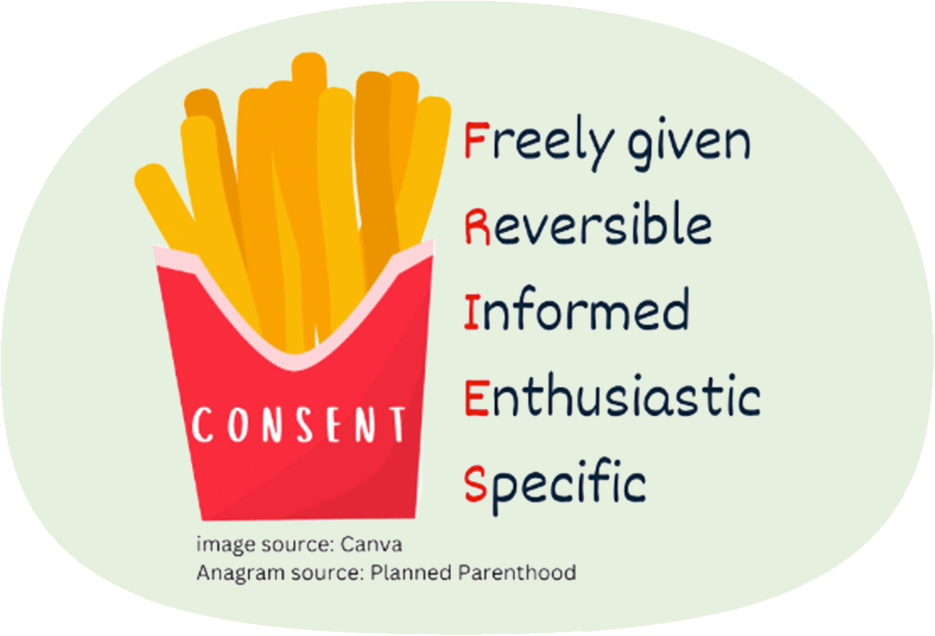
Let's talk about Consent.
A. Table of Expressions of consent
Words / Phrases that Express Consent *
- “Yes.”
- “I agree.”
- “Sure.”
- “It’s okay for me.”
- “I/We can do it.”
- “I’d like/love to.”
B. Table of Words / Phrases / Situations that Do Not Show Consent
Words / Phrases / Situations that Do Not Show Consent *
- “No.”
- “Maybe / I’m not sure.”
- “I’m not interested.”
- “I don’t like/want to.”
- “I am not/don’t feel comfortable.”
- “Stop.”
- “I don’t think this is right.“
- The person being asked for consent is: asleep, sick, intoxicated by alcohol or drugs, etc.
- Intimidating or persuading someone (of legal age, or under the legal age, or mentally incapacitated individuals)
- Deciding on your own or assuming the other party would agree.
- Visibly uncomfortable or disengaged with the act.
- A person who has initially given consent but changed their mind along the course of the act is an indication of a refusal to push through.
- “Yes.”
- “I agree.”
- “Sure.”
- “It’s okay for me.”
- “I/We can do it.”
- “I’d like/love to.”
B. Table of Words / Phrases / Situations that Do Not Show Consent
Words / Phrases / Situations that Do Not Show Consent *
- “No.”
- “Maybe / I’m not sure.”
- “I’m not interested.”
- “I don’t like/want to.”
- “I am not/don’t feel comfortable.”
- “Stop.”
- “I don’t think this is right.“
- The person being asked for consent is: asleep, sick, intoxicated by alcohol or drugs, etc.
- Intimidating or persuading someone (of legal age, or under the legal age, or mentally incapacitated individuals)
- Deciding on your own or assuming the other party would agree.
- Visibly uncomfortable or disengaged with the act.
- A person who has initially given consent but changed their mind along the course of the act is an indication of a refusal to push through.
- “No.”
- “Maybe / I’m not sure.”
- “I’m not interested.”
- “I don’t like/want to.”
- “I am not/don’t feel comfortable.”
- “Stop.”
- “I don’t think this is right.“
- The person being asked for consent is: asleep, sick, intoxicated by alcohol or drugs, etc.
- Intimidating or persuading someone (of legal age, or under the legal age, or mentally incapacitated individuals)
- Deciding on your own or assuming the other party would agree.
- Visibly uncomfortable or disengaged with the act.
- A person who has initially given consent but changed their mind along the course of the act is an indication of a refusal to push through.