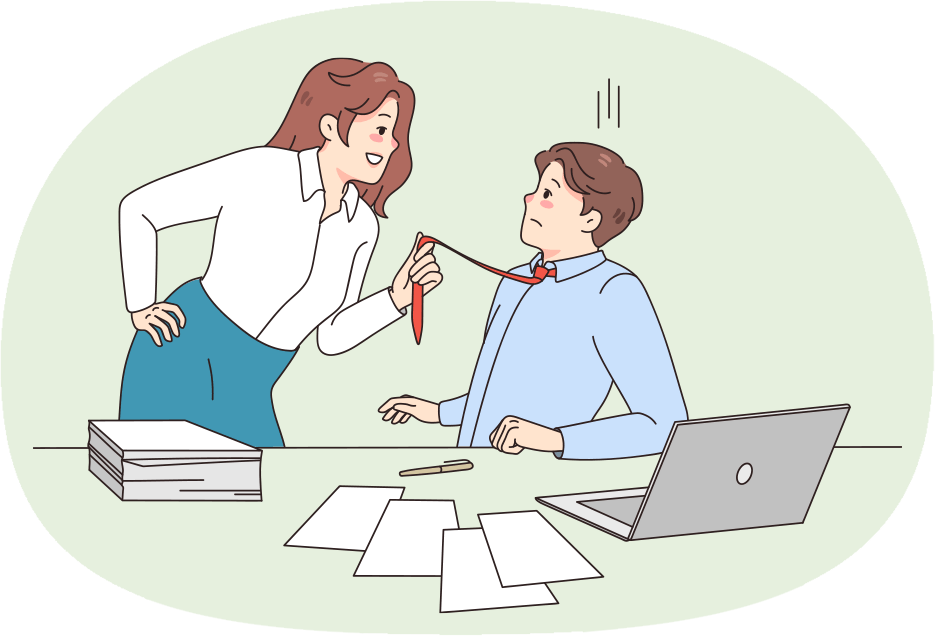
Use this checklist to identify if you may be experiencing abuse:
1. Sexual Harassment
Sexual harassment occurs when someone violates boundaries through unwanted sexual advances, remarks, gestures, or actions. Here are key elements to remember:
Consent Matters:
Unwanted and Persistent:
No Power Dynamics:
Impact, Not Intent:
Boundaries Are Valid:
Forms:
‘Quid pro quo’ sexual harassment
Verbal Sexual Harassment
“Miss pretty saan punta mo? Hatid na kita.” (Catcalling)
“Hi baby ang daks mo!” (Catcalling)
“My boss said during our meeting, I heard you’re really good at handling... things. Maybe you can handle me too.’” (Indecent Sexualized Innuendo)
“You’re making it hard for the men/women to focus because you are being too hot.” (Indecent Sexual Remark)
“A coworker shared an explicit story about their sexual escapades and said, ‘You should try this—it might spice up your life.’” (Sexualized Storytelling)
“While I was working late, my manager said, ‘You know, the way you sit is so... inviting.’” (Suggestive Remark)
“A classmate told me, ‘You’d look even hotter without that jacket on.’” (Suggestive Remark About Appearance)
“My boss told me, ‘Looks like you’ve been working hard. Maybe you deserve some... personal attention.’"(Sexual Innuendo)
“My classmate asked, ‘So, how many people have you slept with?’ and laughed when I didn’t answer.” (Inappropriate Question About Personal Life )
“During lunch, someone asked me, ‘Are you still a virgin?’ even though it’s none of their business.” (Inappropriate Question About Sexual History)
“In our class group chat a member told me,‘Wow, ang hot mo sa suot mong damit kanina. Hindi ko maialis ang tingin ko sa'yo.’" (Suggestive Remark About Appearance)
“A colleague keeps asking, ‘Are you dating someone? What’s their name? What do they look like?’ even after I said I don’t want to talk about it.’” (Persistent Inquiry About Dating Life )
“Someone I barely know keeps texting me, ‘What’s your home address? I just want to send you something.’” (Invasive Personal Question )
“During lunch, a coworker joked, ‘Why are women bad drivers? Because there’s no road from the kitchen to the bedroom.’” (Offensive Sexist Joke )
“A friend said, ‘What do you call a lesbian dinosaur? Lickalotapuss,” and everyone laughed while I felt embarrassed.’” (Homophobic Green Joke )
“My co-worker cracked a joke, ‘Ang mga bakla daw, mahilig sa fast food. Bakit? Kasi gusto nila ‘chupa-chups!’” (Homophobic Green Joke)
“My professor keeps saying, ‘Let’s meet alone after class to discuss your grades’, even though I’ve already said I’m uncomfortable with that. (Persistent Invitation to Be Alone )
“A coworker repeatedly asks, ‘Let’s grab a drink after work—just the two of us,’ even after I said I’m not interested.” (Relentless Pursuit of Private Meeting )
“My gym instructor said, ‘You’ve got great legs—I wouldn’t mind seeing them more often.’” (Unwarranted Remark About Body Parts )
“Someone used my name in a sexually vulgar article or piece without my permission.”
“Kamusta naman ang sex life mo?” (Indecent Sexual Questions)
“Pang ilan mo na siya?/Pang ilan ka na sa mga nakasama niya?” (Indecent Sexual Questions)
Behavioral sexual harassment
“I experienced a person making sexual gestures directed at me, specifically by mimicking a dry-humping motion using their body.” (Sexual Gesture)
“I witnessed someone intentionally rubbing their genitals in front of me.” (Indecent Exposure to Sexual Act)
“Someone made me watch them engage in other sexual acts without my consent at home, public or private vehicles, streets. schools/university, or office, etc.”(Indecent Exposure to Flashing)
“While I was walking on the street, someone called out to me saying, Hi, Miss Sexy! Ganda naman ng legs mo!’ at sabay nag-whistle.’” (Catcalling and Wolf-Whistling)
“While scrolling through my phone, I received a message from an unknown number that said, ‘Send me a sexy pic or else I’ll make one up and post it’. (Sexual Harassment via Text Message)
“While I was sitting in the cafeteria, I noticed someone staring at my chest for several minutes with a smirk on their face.” (Intrusive Gaze)
“While walking home, a man stopped in front of me, unzipped his pants, and exposed himself without saying anything.”(Indecent Exposure)
“While waiting for the bus, a man stuck out his tongue and made licking motions at me while staring directly at me.” (Sexual Gesture with Mouth)
“Someone walked past me and made a thrusting motion with their hips as they laughed.” (Sexual Gesture with Body)
While I was sitting in a quiet corner of the library, I noticed a man in the corner staring at me while touching himself.” (Public Masturbation)
“While walking up the stairs to catch the MRT, I realized someone was secretly taking photos under my skirt without my consent.”(Voyeurism via Camera)
“Every time I leave work, I notice the same person following me from a distance and waiting outside my building.”(Physical Stalking)
“I keep getting messages on all my social media accounts from someone I’ve already blocked, creating new accounts to contact me.”(Cyberstalking)
“My professor constantly calls or sends me personal messages even in the middle of the night to seek for ‘support’.”(Boundary Violation)
“My colleague/ supervisor/ subordinate keeps on seeking solace in me, often borderline sexual already.” (Boundary Violation)
“Someone threw water at me to make my clothes appear see-through as a prank and filmed me without my consent.” (Filming Pranks)
“Switching male and female bathroom signages”(Filming Pranks)
“Filming ‘social experiments’ of touching women’s bottoms without their consent (Filming Pranks)
“While walking to my car, someone tugged at my skirt, making me feel exposed.” (Pulling Clothes Up, Down, or Off)
“At a party, someone jokingly pulled the strap of my dress down, saying they were ‘just kidding.’”(Pulling Clothes Up, Down, or Off)
Online sexual harassment
“Someone sends me pictures or videos that are sexual in nature with which I do not consent to.”
“My ex-boyfriend shared my nude photos online after we broke up, threatening me to get back together with him or he would spread them further.”
“A person I met online pressured me into sending explicit content, promising love and commitment, and then later used the images to blackmail me."
“In our group chat a member told me, ‘Wow, ang hot mo sa suot mong damit kanina. Hindi ko maialis ang tingin ko sa'yo.’"
“Someone created a fake social media profile using my pictures and posted sexually explicit content under my name.”
“I received an email from an anonymous sender that contained a graphic image of a naked drawing meant to look like me.”(Sexual Harassment via Graphic Drawings)
“Someone edited my face in sexual photos and/or videos I did not consent to, I am tagged in social media posts that contain sexually explicit images, videos or messages”
"While on a video call, he suddenly exposed himself, saying, ‘I just want to show you how much I like you.’ I felt disgusted and violated." (Non-Consensual Exposure Online)